The first bottom planking panel is on. 1 down, 3 to go. That is the good news, and that is the main point.
Getting there, however, didn’t go quite as smoothly as I’d hoped.
It was a Sunday night, and the pre-fitted panel was off of the boat. Before it got too late, I figured I’d go ahead and glue it down. After all, I would really like to get this boat in the water this year.
One small step was in the way: I still needed to finish encapsulating 3 limbers on frame #1. That takes a different type of epoxy than the stuff needed for gluing. No problem. I had 3 mixing containers.
Ominous foreshadowing #1: Not wanting to waste time, I’d only cleaned two of the three mixing cups.
The encapsulation part went fine. Just a few ounces of System 3 SilverTip. Quick and easy. On to mixing the GelMagic epoxy for gluing.
That went fine, too. That is, until I spread the last of it onto the final remaining inches of the boat frame, realizing as I did so that I had no epoxy left to spread onto the plywood.
Best practice is to coat both mating surfaces. Best practice is to use a clean mixing cup for each batch of epoxy. Now, I had one cup with still-curing SilverTip, one cup I didn’t bother to clean, and the last cup which I had just used.
Since the epoxy on the boat would start kicking off at any minute, I had to make a split-second decision: Either mix more GelMagic in one of the dirty cups, or hope what I’d put on the framework was enough on its own. With best practice being to coat both surfaces, I hurriedly scraped out the GelMagic cup as best I could & hoped there wouldn’t be a problem mixing more in it.
I quickly poured in about the same amount of resin. (That is, as “quickly” as one can “pour” GelMagic.)
I calculated the amount of hardener needed, quickly grabbed the bottle, opened it & upturned it....
...which is when I quickly found out I’d added the wrong hardener. GelMagic hardener is amber in color, and very viscous. This stuff was clear and flowed like water. It was the SilverTip hardener, not the GelMagic, and now I’d just wasted both.
I calmly murmured a string of socially-acceptable phrases, and pondered my next move.
I had more epoxy, but the last remaining mixing cup was full of junk. It still had hardened clumps of SilverTip thickened with mahogany sawdust clinging tenaciously to its inner walls. There was no time to clean it.
So, I made another rush decision & decided to use it. The clumps started breaking free as I mixed the batch of GelMagic. I picked them out as best I could as I spread the epoxy onto the plywood. That in itself added more time to an already urgent task.
It takes a long time to hand-drive 97 screws. It takes longer when you’re having to bend plywood against its will in the process. It took long enough, in fact, that by the time I drove the last screw into place the epoxy was so viscous I could barely manage scraping it with the putty knife. It was also late by this point. I was tired and exhausted.
I was so tired, in fact, that I forgot something very important. I forgot to reach underneath the planking and scrape away epoxy along the battens, where I will need to fit the butt blocks for joining the planking panels. Ugh...
Chipping away at THAT for the last 3 days has been fun, I assure you.
Oh well. The first bottom panel is on, and it is on solidly. That is the good news, and that is the main point.
Read More..
Getting there, however, didn’t go quite as smoothly as I’d hoped.
It was a Sunday night, and the pre-fitted panel was off of the boat. Before it got too late, I figured I’d go ahead and glue it down. After all, I would really like to get this boat in the water this year.
One small step was in the way: I still needed to finish encapsulating 3 limbers on frame #1. That takes a different type of epoxy than the stuff needed for gluing. No problem. I had 3 mixing containers.
Ominous foreshadowing #1: Not wanting to waste time, I’d only cleaned two of the three mixing cups.
The encapsulation part went fine. Just a few ounces of System 3 SilverTip. Quick and easy. On to mixing the GelMagic epoxy for gluing.
That went fine, too. That is, until I spread the last of it onto the final remaining inches of the boat frame, realizing as I did so that I had no epoxy left to spread onto the plywood.
Best practice is to coat both mating surfaces. Best practice is to use a clean mixing cup for each batch of epoxy. Now, I had one cup with still-curing SilverTip, one cup I didn’t bother to clean, and the last cup which I had just used.
Since the epoxy on the boat would start kicking off at any minute, I had to make a split-second decision: Either mix more GelMagic in one of the dirty cups, or hope what I’d put on the framework was enough on its own. With best practice being to coat both surfaces, I hurriedly scraped out the GelMagic cup as best I could & hoped there wouldn’t be a problem mixing more in it.
I quickly poured in about the same amount of resin. (That is, as “quickly” as one can “pour” GelMagic.)
I calculated the amount of hardener needed, quickly grabbed the bottle, opened it & upturned it....
...which is when I quickly found out I’d added the wrong hardener. GelMagic hardener is amber in color, and very viscous. This stuff was clear and flowed like water. It was the SilverTip hardener, not the GelMagic, and now I’d just wasted both.
I calmly murmured a string of socially-acceptable phrases, and pondered my next move.
I had more epoxy, but the last remaining mixing cup was full of junk. It still had hardened clumps of SilverTip thickened with mahogany sawdust clinging tenaciously to its inner walls. There was no time to clean it.
So, I made another rush decision & decided to use it. The clumps started breaking free as I mixed the batch of GelMagic. I picked them out as best I could as I spread the epoxy onto the plywood. That in itself added more time to an already urgent task.
It takes a long time to hand-drive 97 screws. It takes longer when you’re having to bend plywood against its will in the process. It took long enough, in fact, that by the time I drove the last screw into place the epoxy was so viscous I could barely manage scraping it with the putty knife. It was also late by this point. I was tired and exhausted.
I was so tired, in fact, that I forgot something very important. I forgot to reach underneath the planking and scrape away epoxy along the battens, where I will need to fit the butt blocks for joining the planking panels. Ugh...
Chipping away at THAT for the last 3 days has been fun, I assure you.
Oh well. The first bottom panel is on, and it is on solidly. That is the good news, and that is the main point.
 |
| With the forward panel removed, this is how I marked the lines to cut butt blocks from a scrap of plywood. |
 |
| The Utilitys framework & the Zips stem assembly. |
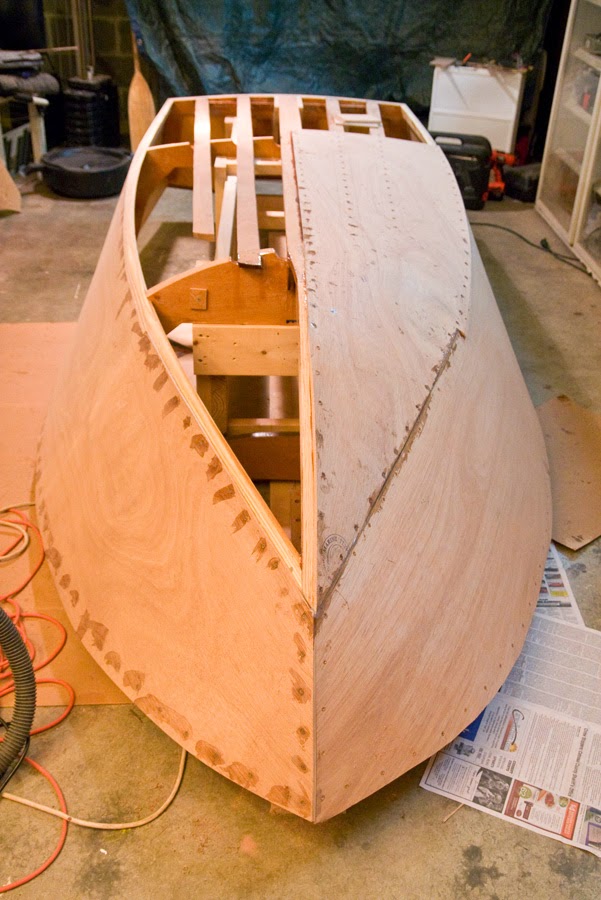 |
| First bottom panel epoxied on. |
 |
| Fitting at the stem. |
 |
| Transition joint. |
 |
| My daughters Hello Kitty mirror was a huge help in chipping away at that epoxy. |


